January 22, 2014

TRAVEL & TOURIST GUIDE


Travel and tourism provide services of all types for both inbound and outbound travelers, and have become one of the world's fastest growing industries. International travel and tourism are the world's largest export earner and an important factor in the balance of payments of most nations. The market is increasingly diverse, covering not only traditional sunshine tourism and business trips but also many new types of travel that have developed in recent years. Tourism has become one of the world's most important sources of employment. It covers a wide range of jobs, including all branches of the travel industry, hospitality in hotels and restaurants, entertainment and recreation, as well as the tourist attractions in a particular region. Areas of work include Tour Operators, Travel Agencies, Tourist Boards and Tourist Information Centres, Transport Companies, Tour Guides, Tourist Attractions.


Characteristics of  a Great Tour Guide.

Frist, Understandable , your tour guide should speak a range of languages, including your own, as well as the local lingo. They should also speak clearly, audibly and with confidence. Depending on the type of tour, you might be asked to wear earphones or use other types of audio equipment.

Second, Punctual ,Your tour leader should be waiting for you when you arrive, rather than the other way around. Ideally, they should also ensure that other tour members arrive and depart on time, and don’t cause delays for the group as a whole.

Third ,Friendly ,A relaxed and friendly manner is key to a great tour guide. They also need to have a certain level of authority, and be able to keep tour members together and focused without coming across as intimidating, patronizing or arrogant – not a good look in a tour guide.

Fourth, Knowledgeable ,A good tour guide has an in-depth knowledge of the site, its history and importance. A great tour guide has a passion for their subject and can convey their enthusiasm to the group. Such passion can be contagious and inspiring, and make the site really come alive. Being able to convey a sense of the overall cultural background is also important, as it can greatly enhance each tour member’s overall understanding of the site as a whole.

Fifth, Engaging ,Great tour guides share their knowledge in an engaging, illuminating and entertaining way, rather than repeating a list of facts by rote.

Sixth, Interactive ,Effective tour guides also invite questions and interaction from tour members, rather than treating the tour as a one-person show or a ‘be quiet and listen’ school lesson.

Seventh, Funny ,A certain level of friendly humour is essential. Equally, a good tour guide also knows when to include a little quiet time, and when to let the site speak for itself.

Eighth, Observant The tour needs to be relevant to a broad range of people, including different age groups. A good tour leader also needs to be aware of tour members with special needs.

Ninth, Good Pacing ,Whether the speed of the narrative or the pace of a walking tour, it should be neither too fast nor too slow. Like Goldilocks, it should be just right.

And Last, Flexible ,When appropriate, a flexible approach can make the difference between a good and a great tour guide. Being flexible means being open to serendipity, taking a moment to enjoy spontaneous moments like a particularly perfect sunset.


The tourism industry tries to meet the needs of all types of tourists by providing suitable facilities and services for each category.
  • v  Business tourist: travel is related to business and the world of work. MESE which stands for meetings, exhibitions and special events. These are all part of the business world. All major cities have conference centres that cater for the needs of business tourists. An example of a business tourist would be a salesman who travels to another city to attend a trade show and promote the products he sells.
  • v  Education tourists: travel to attend a place of learning in another town, city, or country, in order to study for or improve a qualification. They may also be people that attend workshops to learn new skills or improve existing ones. A clinic nurse who travels to another province to attend a workshop about infectious diseases is an example of an educational tourist.
  • v  Incentive tourists: are people who are rewarded in the form of a company paid holiday for their hard work, or for achieving goals set by their company. This incentive to travel motivates employees to work harder, improves work relationships, and builds team spirit. A salesman who receives a holiday package for achieving the most sales in the company is an example of an incentive tourist.
  • v  Health or medical tourist: travel because they want to visit a holiday spa, needs medical special treatment that is only available away from home, undergo procedures that are cheaper in another country, or are recovering from an illness in a healthier climate. Many tourist come from oversees countries to South Africa to have plastic surgery.
  • v  Adventure tourist: want an unusual and exciting experience. They want to participate in activities that may be dangerous, such as rock climbing, river rafting, skydiving, shark cave diving and bungee jumping.
  • v  Cultural tourist: want to experience different cultures, such as San rock art, or cultural related festivals such as the National Art Festival in Grahams-town, or the International Jazz Festival in Cape Town. They would also want to experience the World Heritage Sites in the country.
  • v  Eco-tourists: travel to experience nature such as traveling to Bonita Gardens in Bloemfontein South Africa
  • v  Leisure tourist: want to rest and relax and have a break from the usual routine Examples of this type of tourism are a cruise on a cruise liner, a trip on a Blue train, attending a special music special music performance or relaxing on the beach.
  • v  Religious tourist: want to see and experience places of religious importance. There are many religious destinations in the world such as the Hajj in Mecca, Jerusalem in Israel, Varanasi in India, and the Vatican in Rome. During Easter the largest Christian pilgrimage to Zion City, Moria, Limpopo, takes place. More than a million pilgrims travel to Moria to every Easter.
  • v  Shopping tourist: travel to shopping malls, shopping centres, factory shops, crafts market, festivals, and touring shopping routes such as the Midlands in KwaZulu-Natal. Their main purpose is to buy items.
  • v  Special interest tourist (STI): have particular interest such as bird watching, food and wine, flowers, fishing during the Sardine Run, or attending the Cape Town Book Fair.
  • v  Sport and recreation tourist: participate in or watch sporting events. Popular events include the Soccer World Cup, Winblendon Tennis Championship, Comrades Marathon, and Fisher River Canoe Marathon. Surfing, mountain climbing, cricket, swimming, golf and tennis are popular sports.
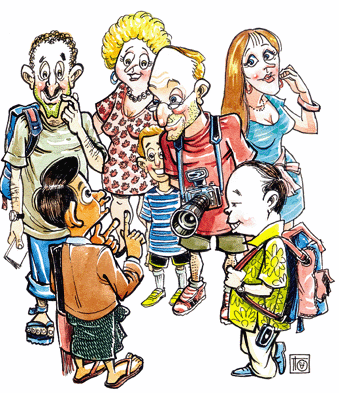
Most important characteristics to develop in myself.
  • v  At least speak a foreign language is English.
  • v  There are those who seek knowledge and knowledge regularly.
  • v  Love to travel and adapt services and tackle well in all situations.
  • v  Flexibility, compromise and looks warm benevolence as the trust of travelers.
  • v  Leadership is the courage with prudence and precaution.
  • v  Cheerful attitude a sacrifice, honesty, integrity and patience.
  • v  Completely healthy Witty and very uninspired
  • v  Be creative Have a good relationship
  • v  Love is a great communicator , and the various lectures .
  • v  As well as data storage tourism. Customer goodwill and customer contacts a traveler.


January 15, 2014

Travel & Tourist


             According to A study by the Thailand Development and research Institute (TDRI)showed that about 31 percent of international tourists obtained information about Thailand from their friends. Only 15  percent got the information from tour operators whereas about 12 percent got information from both sources.To attract those who have not yet decided their holiday destination, It is necessary to impress the  foreign tourist already in Thailand.However, a survey in 1990-1991 by the Intrama World Destination Monitor put Thailand second only to Hong Kong as a place where 1,450 tour operator around the world said tourists were likely to be cheated or overcharged in Asia. India came in third. Italy was considered to be the number one country in the world where tourists were most likely to be cheated.


             First, Consumer behavior refers to the process of acquiring and organizing information in the direction of a purchase decision and of using and evaluating products and services. This process encompasses the stages of searching for, purchasing, using, evaluating, and disposing of products and services. The tourist buying decision presents some unique aspects: it is an investment with no tangible rate of return, and the purchase is often prepared and planned through savings made over a considerable period of time. That is, the vacation tourist will invest with no expectation of material and economic return on his or her purchase of an intangible satisfaction. As travelers become more sophisticated in their vacationing behavior, research must continue to become more sophisticated to explain this behavior. To take adequate actions in the area of tourism marketing, one must understand how people perceive such things as destination areas, air travel, travel distances and travel advertising; how they learn to consume and to travel; how they make travel decisions; and how personality affects those decisions (Moutinho, 1987). Choosing the travel destination is a very important and long-way decision process for the tourist, and understanding of the factors that influence decision-choice process is extremely important for the tourism industry. In order to stay competitive in this very competitive industry, tourism organizations should understand the decision process of their tourists that can be divided into different target markets (Costa and Ferrone, 1995).


            Second, A survey in 1990-1991 by the INTRAMA World Destination Monitor, Thailand was ranked on the second place where the tourists were likely to be cheated in Asia. The tourists may feel betrayed and are more likely to go somewhere else for the similar products or services. Thailand may also get a bad reputation as a deceptive country, which means decreased revenues in the future. Therefore, it may be difficult for the tourists to accept and trust but their awareness in ethics can be altered and Thailand will gain loyalty from customers again.

            Finally, Can resolve this problem.  By set the standard of price, accommodation and other services.  
Indicates the development of tourism in Thailand. To create a good image for the tourists.  And attract tourists back to Thailand again.


January 8, 2014

Special Interest Tourism

Special Interest Tourism is a category of tourism that involves people with particular interests such as painting, cooking or bird-watching. The tourists who fall under this category are mainly people with very particular needs on visiting a place. For example, you can have a tourist in a particular national park just for bird watching.

A range of special interest tourist categories


Regional Tourism – Growth in interest in travel to regions of the UK and the major cities within regions, supported by upgrading of transport links and attractions.


 • Cultural Tourism - Turning visits to arts, sports and other events into a weekend stay or centre-piece of a holiday.


Heritage Tourism - Impact of Lottery funding to upgrade existing heritage sites and create visitor attractions at new locations. Growing interest in the heritage of industrial age in Britain, as we fully embrace the post-industrial era.


Rural Tourism – See activity on Tourism in the Countryside.


Educational Tourism – for example, learn a language in the country where it is spoken.


 • Cycle Tourism – Integrating transport links to enable people to tour further afield on their (or hired) bicycles.


Travelling for Health – The growth and re-birth of spa and health resorts. Personal well-being becomes the focal point of the tourism experience.


Environmental Tourism - ‘Green’ holiday locations and activities include environmentally-friendly forms of travel as well as visitor locations offering ‘green’ experiences.


Wine and Food Tourism - Food and wine festivals, journeys through wine and food producing areas. Travel and activity form part of the entire holiday experience.


The Cruise Experience - This sector has seen rapid growth in the past twenty years.


Festivals and Events Tourism - Celebrating global, national and regional festivals and events. Cultural and religious festivals especially popular.


Seniors Tourism - Boosted by increased life expectancy in the developed world and by a general rise in affluence of some senior citizens, the market for ‘grey’ tourism is expanding. 

December 25, 2013

KOH LAN island


Koh Lan is a wonderful little-island in the Thailand. Koh Lan is located about 7 km off the coast of pattaya beach of which is about two hours drive south of Bangkok. The Island is about 4 km in length and about 2 km wide. The main village is called Na-ban.


There are boat connecting Koh Lan to the mainland. The boat ride takes about 50 minutes. Boat go and leave south pattaya bali-hai pier daily .


There are many activities here for visitors to enjoy, some include para-saling, snorkeling, jet-ski, banana boat, swimming in tropical waters, and there is even a shooting range located here.


Most of Koh Lan’s beaches are on its western side. The most visited one is Tawaen Beach, where there is a small harbor. All the length of the beach is lined with small tourist shops behind which are dining halls of restaurant whose menu is based mainly on fish and seafood. Other beaches are Tonglang Beach, Tien Beach, Samae Beach and Naon Beach.


We rented a motorbike to go around  exploring the island. Most of the motorbikes have automatic clutch,  so you don’t even need to shift gears.


Tawaen beach is the biggest and busiest.  Lots of restaurants, some shops, all activities available. It’s a bit crowded for some tastes, but some people may like that.  The water is beautiful, and some boats go directly to this beach, where there is a boat-dock , making it easily accessible.


Samae Beach considered the prettiest beach, somewhat more upscale than the other places.  Nice selection of quality restaurants.  Somewhat more spacious, the place is big but doesn’t seem that crowded.


Nual Beah on the far end of the island;  very quiet, only a handful of people. This beach sometimes has nudist.


We rented a bungalow for the night at bankoonsok Resort. 

December 4, 2013

Travel and Tourism Future Trends


The travel and tourism industry is vulnerable to the state of the economy - as the economy recovers and people have more money to spend on holidays the industry is predicted to grow again.

Business travel too has suffered with those needing to travel during the recession seeking out cheaper deals and budget airline routes.

Jobs in travel and tourism are expected to have modest growth of about 60 thousand jobs by 2017 as the UK comes out of the recession.

The larger budget airlines continue to expand and develop routes outside Europe - although some have not managed to survive the recession. For example the Scottish Budget airline group' FlyGlobespan' , the 'XL Leisure group' airline and 'Sky Europe' were all smaller airlines that have not survived the loss of income from lower passenger numbers.

Large travel conglomerations, such as the international UK based TUI group, are set to continue to dominate the industry - as they can take advantage of significant changes in the travel and tourist markets that the smaller groups may not be able to do so.  For example air transport and tourism is forecast to grow substantially as a result of strong demand from the Asian market but companies would need a foothold in Asia to benefit from this.

The UK is limited in the level of future growth it will be able to achieve in air travel as airports reach their full capacity. There are plans to expand some airports and discussions about for example bringing Coventry airport back into operation if it can get planning permission to develop. It is argued that if UK airports increase capacity, air transport will continue to grow but there are also environmental pressure groups who argue that air capacity should not increase.

Online booking and automated check in has affected the number of administration and airport services staff and this trend is likely to continue. 

Travel agency retail outlets are set to continue the trend of becoming fewer in number but bigger. TIU have recently opened a new 'walk-in holiday experience' in Coventry - a holiday superstore where staff offer more individual specialist advice and access to multi-media information for example being able to watch a DVD about a cruise. Specialist staff will be able to give advice about and book weddings and honeymoons for example. TIU plan to open more of these outlets across the UK.


November 27, 2013

World Tourism Organization (UNWTO)


The United Nations World Tourism Organization (UNWTO) is the United Nations agency responsible for the promotion of responsible, sustainable and universally accessible tourism.

As the leading international organization in the field of tourism, UNWTO promotes tourism as a driver of economic growth, inclusive development and environmental sustainability and offers leadership and support to the sector in advancing knowledge and tourism policies worldwide.

UNWTO encourages the implementation of the Global Code of Ethics for Tourism to maximize the contribution of tourism to socio-economic development, while minimizing its possible negative impacts, and is committed to promoting tourism as an instrument in achieving the United Nations Millennium Development Goals (MDGs), geared towards reducing poverty and fostering sustainable development.

UNWTO generates market knowledge, promotes competitive and sustainable tourism policies and instruments, fosters tourism education and training, and works to make tourism an effective tool for development through technical assistance projects in over 100 countries around the world.

UNWTO’s membership includes 156 countries, 6 territories and over 400 Affiliate Members representing the private sector, educational institutions, tourism associations and local tourism authorities.

Accessible tourism is the ongoing endeavor to ensure tourist destinations, products and services are accessible to all people, regardless of their physical limitations, disabilities or age. It encompasses publicly and privately owned tourist locations. 


Accessible tourism enables people with access requirements, including mobility, vision, hearing and cognitive dimensions of access, to function independently and with equity and dignity through the delivery of universally designed tourism products, services and environments. This definition is inclusive of all people including those travelling with children in prams, people with disabilities and seniors.

Sustainable tourism is attempting to make as low an impact on the environment and local culture as possible, while helping to generate future employment for local people. The aim of sustainable tourism is to ensure that development brings a positive experience for local people, tourism companies and the tourists themselves. Sustainable tourism is an adopted practice in successful ecotourism Global economists forecast continuing international tourism growth, the amount depending on the location. As one of the world's largest and fastest growing industries, this continuous growth will place great stress on remaining biologically diverse habitats and indigenous cultures, which are often used to support mass tourism. Tourists who promote sustainable tourism are sensitive to these dangers and seek to protect tourist destinations, and to protect tourism as an industry.


Sustainable tourists can reduce the impact of tourism in many ways:
informing themselves of the culturepolitics, and economy of the communities visited
anticipating and respecting local cultures, expectations and assumptions
contributing to intercultural understanding and tolerance supporting the integrity of local cultures by favoring businesses which conserve cultural heritage and traditional values supporting local economies by purchasing local goods and participating with small, local businesses conserving resources by seeking out businesses that are environmentally conscious and by using the least possible amount of non-renewable resources Increasingly, destinations and tourism operations are endorsing and following "responsible tourism" as a pathway towards sustainable tourism. Responsible tourism and sustainable tourism have an identical goal, that of sustainable development. The pillars of responsible tourism are therefore the same as those of sustainable tourism – environmental integrity, social justice and economic development. The major difference between the two is that, in responsible tourism, individuals, organizations and businesses are asked to take responsibility for their actions and the impacts of their actions. This shift in emphasis has taken place because some stakeholders feel that insufficient progress towards realizing sustainable tourism has been made since the Earth Summit in Rio. This is partly because everyone has been expecting others to behave in a sustainable manner. The emphasis on responsibility in responsible tourism means that everyone involved in tourism – government, product owners and operators, transport operators, community services, NGOs and Community-based organization CBOs, tourists, local communities, industry associations – are responsible for achieving the goals of responsible tourism.


Global Code of Ethics for Tourism
The Global Code of Ethics for Tourism is intended to be a living document. Read it. Circulate it widely. Participate in its implementation. Only with your cooperation can we safeguard the future of the tourism industry and expand the sector's contribution to economic prosperity, peace and understanding among all the nations of the world.

The Code’s 10 principles amply cover the economic, social, cultural and environmental components of travel and tourism:

Article 1: Tourism's contribution to mutual understanding and respect between peoples and societies

Article 2: Tourism as a vehicle for individual and collective fulfillment
Article 3: Tourism, a factor of sustainable development
Article 4: Tourism, a user of the cultural heritage of mankind and contributor to its enhancement
Article 5: Tourism, a beneficial activity for host countries and communities
Article 6: Obligations of stakeholders in tourism development
Article 7: Right to tourism
Article 8: Liberty of tourist movements
Article 9: Rights of the workers and entrepreneurs in the tourism industry
Article 10: Implementation of the principles of the Global Code of Ethics for Tourism


The Tourism Authority of Thailand (TAT) was established on the 18th March 1960. TAT was the first organization in Thailand to be specifically responsible for the promotion of tourism. 


TAT supplies information and data on tourist areas to the public, publicizes Thailand with the intention of encouraging both Thai and international tourists to travel in and around Thailand, conducts studies to set development plans for tourist destinations, and co-operates with and supports the production and development of personnel in the field of tourism. 

Since the inception of the first local office of TAT in Chiang Mai in 1968, there are now 35 regional offices throughout Thailand. TAT has also established many overseas offices the first being in New York, which was opened in 1965. During the past 30 years, TAT has since established 15 more offices in different parts of the world.


The "Seven Amazing Wonders" theme products are: 
  • Thainess: "Experience the art of Thai living" - which refers to traditional Thai hospitality, lifestyle and friendliness of the people.
  • Treasure products: "Land of Heritage and history" - covering the World Heritage sites and historical places, temples and Thai museums.
  • Beaches: "Fun ,Sun, Surf and Serenity of Thai beaches" - the long-standing popularity of Thailand beach resorts for international and domestic tourism.
  • Nature: "Encounter the sheer beauty of Thai nature" - focus on conservation and environment, and market Thai products within the framework of worldwide attention being paid to global warming.
  • Health and Wellness: "Land of healthy smile" - a rapidly growing market, highlighting Thailand's preventive and curative therapies.
  • Trendy: "Excite yourself with a myriad of Thai trends" - target at the new generation of young travelers and covering the new boutique hotels, shopping  centers , restaurants, nightlife and entertainment.
  • Festivities: "Enhance yourself with International festivities in Thailand" - the 'sanuk' (fun) factor, featuring popular Thai events and festivals such as the Phuket Regatta, Elephant Polo etc.


Thailand is a wondrous kingdom, featuring Buddhist temples, exotic wildlife, and spectacular islands. Along with a fascinating history and a unique culture that includes delectable Thai food and massage, Thailand features a modern capital city, and friendly people who epitomize Thailand’s “land of smiles” reputation.

Thailand travel is convenient for visitors as there are many ways to get to Thailand and even more ways to travel in Thailand, whether your destination is Bangkok, Phuket, Chiang Mai, or the most remote provinces.

Thailand features not only one of the finest cuisines in the world but also a wide selection of restaurants serving authentic Italian, Japanese, Middle Eastern, and other global cuisines. Find restaurants, recipes, and cookery classes to fill your holiday with epicurean pleasure.